
Screen Printing vs. DTF vs. DTG vs. Embroidery: How to Pick the Right Method for Your Shirts
Almost every week, someone walks into our Hialeah Gardens shop with a logo on their phone and one question: which printing method should I use? Screen printing, DTF (direct to film), DTG (direct to garment) and embroidery all put your design on a shirt. They differ in price, and they feel and wear differently too. The right choice depends on how many pieces you need, what fabric they are, how many colors your design has and how you want the finished piece to look.
We have been printing for Miami-Dade businesses and teams for more than 10 years, and we run all four methods under one roof. So we have no reason to push one over another. Here is how we help customers decide.
The Quick Answer
If you only have a minute, use this table as a starting point. The sections below explain each method in more detail.
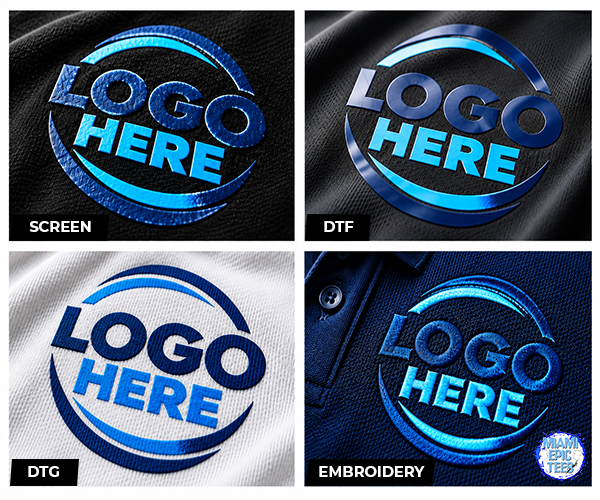
| Method | Best for | Order size | Fabric | How it feels |
|---|---|---|---|---|
| Screen printing | Bold logos with a few colors, crew and event shirts | Larger runs; price per shirt drops as quantity goes up | Cotton, blends, many polyesters | Slightly raised ink, very durable |
| DTF | Full-color designs, small runs, mixed fabrics | 1 piece and up | Cotton, polyester, blends, hats, bags | Smooth layer that sits on the fabric |
| DTG | Photo-quality art on cotton | 1 piece and up | Best on 100% cotton | Very soft, ink soaks into the fabric |
| Embroidery | Polos, hats, jackets, work shirts | 1 piece and up | Most fabrics, especially heavier ones | Stitched thread with a premium texture |
Screen Printing: The Workhorse for Bulk Orders
Screen printing pushes ink through a fine mesh screen onto the shirt. Each ink color gets its own screen, and we run production on an automatic press so every shirt in the order comes out consistent. That setup work is the reason screen printing gets cheaper per shirt as your order grows. Our screen printing starts at $10 per shirt with no hidden minimums, and the price per shirt keeps dropping on bigger runs.
When Screen Printing Makes Sense
Screen printing is the go-to for company tees, event shirts, sports teams and giveaways where you need a lot of the same design. It shines with logos that use one to four solid colors. The ink is thick and durable, which is why we used it for a recent batch of fishing tournament shirts that had to survive sun, salt water and a lot of washing.
When to Skip It
If your design has photos, soft gradients or a dozen colors, screen printing gets expensive fast because every color needs its own screen. It is also rarely the best value for five or ten shirts with a full-color design. That is where DTF and DTG come in.
Specialty Inks
Screen printing also opens the door to specialty finishes. We run metallic gold screen prints, which look sharp on black tees for events, anniversaries and premium merch.
DTF Printing: Full Color on Almost Any Fabric
With DTF printing, your design is printed onto a special film, coated with an adhesive powder and then heat pressed onto the garment. The result is a bright, detailed print with clean edges. It is one of our most requested services because it handles full-color art on small orders without the setup cost of screen printing.
Why Customers Choose DTF
DTF works on cotton, polyester, blends, hoodies, tote bags and hats. That makes it a great fit when one order includes different items, like dri-fit shirts for the crew, cotton tees for the office and a few caps for the owner. There is no big minimum, so you can order one shirt or fifty.
What to Know About DTF
A DTF print sits on top of the fabric as a thin, flexible layer. On small and medium logos you barely notice it. On a large solid block of color covering the whole back, you will feel it more, and it breathes less in Miami heat. If your design has big solid areas, ask us about adjusting the artwork or using screen printing instead.
DTG Printing: Soft, Detailed Prints on Cotton
DTG works like an inkjet printer for clothing. Water-based ink is sprayed straight into the fibers of the shirt, so the print feels almost like part of the fabric. It handles photos, fine detail and thousands of colors without any setup screens.
DTG is at its best on 100% cotton. Dark shirts need a pretreatment step so the colors stay bright, and results on polyester are less vivid. For projects like birthday shirts, family reunion tees, memorial shirts and small merch drops, DTG gives you a soft, high-detail result.
Embroidery: The Professional Finish for Polos and Hats
Embroidery stitches your logo into the garment with thread. First, your artwork is converted into a stitch file, a process called digitizing. Then the machine sews the design, color by color.
Our embroidery services are the first choice for polos, caps, jackets, work shirts and aprons because stitching looks premium and does not crack or peel, even after years of washing.
Limits of Embroidery
Thread has a physical width, so very small text (roughly under a quarter inch tall) and soft gradients do not stitch cleanly. Dense designs can also pucker thin, lightweight tees. When a logo has fine detail, we often simplify it slightly for embroidery or suggest a printed method instead.
3D Puff Embroidery
For hats, 3D puff embroidery adds foam under the stitches so bold letters and shapes stand up off the front panel. It is a popular look for snapbacks and trucker hats, and it works best with thick, simple lettering.
Comparing Cost, Durability and Turnaround
Cost
Screen printing gets cheaper per piece as quantity rises. DTF and DTG have flatter pricing, which makes them strong for small runs and full-color art. Embroidery is priced mainly by stitch count and placement, so a small left-chest logo costs less than a large back design. The crossover point between methods depends on your colors and quantity, so the easiest move is to ask us to price two options side by side.
Durability
Screen printing and embroidery last the longest under heavy use. A well-pressed DTF print holds up very well too. DTG can soften and fade a little faster on shirts that get washed hot every day. Whatever the method, washing inside out in cold water and drying on low will add years to your shirts.
Turnaround
Most orders are ready in as little as 2 days, and same-day is possible in a pinch depending on the method and quantity. If you have a deadline, tell us up front and we will plan the method around it.
Matching the Method to the Job
- A roofing or construction crew that needs 60 shirts in one or two colors: screen printing for the best price per shirt, or DTF if the shirts are dri-fit polyester.
- A restaurant or medical office that wants staff to look polished: embroidered polos with a left-chest logo.
- A quinceañera or birthday party with a full-color photo design: DTG on cotton or DTF.
- A pickleball club ordering 15 performance shirts with a colorful logo: DTF.
- A small brand launching merch: a mix, with screen printing for the core design and DTF for limited colorways.
You can also combine methods on one piece. An embroidered logo on the chest with a DTF print across the back is a common setup for work shirts. Browse our full range of custom apparel printing to see what else we can put your logo on.
Frequently Asked Questions
Is DTF better than screen printing?
Neither is better across the board. DTF wins on small orders, full-color art and mixed fabrics. Screen printing wins on larger runs of simpler designs, where the price per shirt drops and the ink is extremely durable.
Does DTF crack or peel?
A properly pressed DTF transfer is flexible and holds up to regular washing. Most peeling comes from low-quality film or incorrect press settings. Washing inside out and skipping high heat in the dryer helps any print last.
What is the cheapest way to print custom shirts in Miami?
For larger quantities of a simple design, screen printing usually costs the least per shirt, starting at $10 per shirt at our shop. For a handful of full-color shirts, DTF is usually the better value because there are no screens to set up.
Can I use different methods in the same order?
Yes. Many customers order embroidered polos for managers and screen-printed tees for the rest of the team, all in one order and one pickup.